Customer Segmentation in CRM – The Key to Effective Sales Management
Accurate customer categorization and tailoring service to their potential and characteristics is one of the most important strategies for successful sales management. With proper segmentation, sales activities can be precisely adjusted, resources can be used more efficiently, and long-lasting, high-value business relationships can be built.
Flexible Segmentation Tailored to Your Business
Customer categories can be defined flexibly — depending on the industry, sales model, or company strategy. The choice of segmentation criteria should reflect real business needs and support both sales and marketing activities.
Example segmentation criteria include:
• sales value within a defined period,
• number of product segments ordered,
• purchase frequency,
• customer growth potential,
• level of engagement or loyalty.
There is no one universal segmentation matrix — the key is to ensure the chosen structure is understandable for the team and truly supports business goals.
Example segmentation criteria include:
• sales value within a defined period,
• number of product segments ordered,
• purchase frequency,
• customer growth potential,
• level of engagement or loyalty.
There is no one universal segmentation matrix — the key is to ensure the chosen structure is understandable for the team and truly supports business goals.
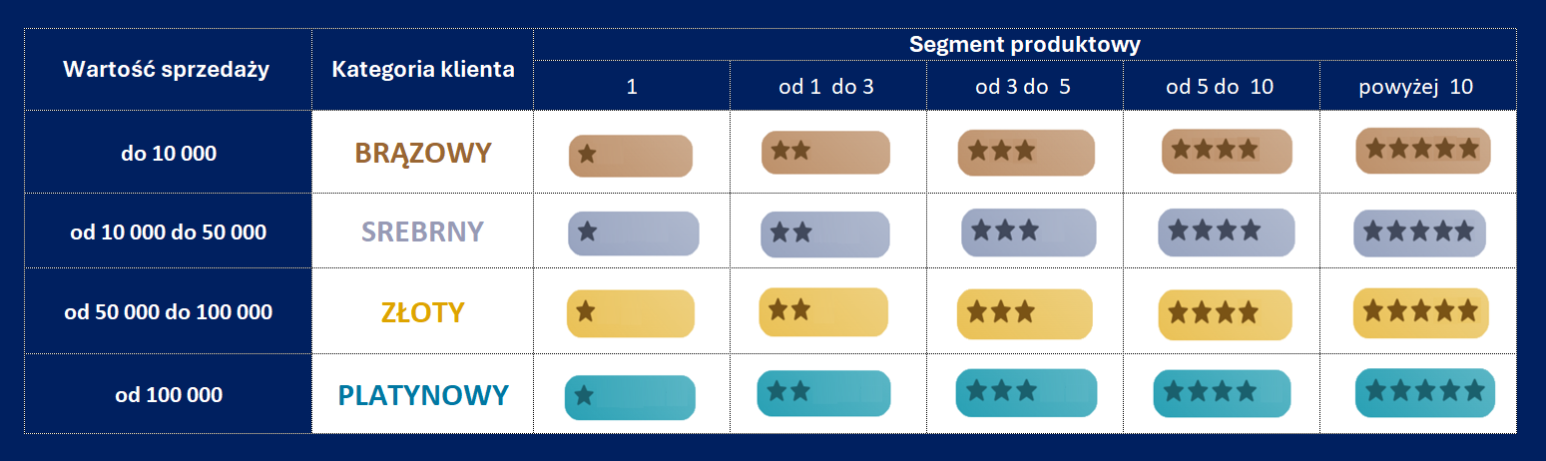
Graphical Presentation in CRM
Once a customer is assigned to a specific category, their profile — and every related sales opportunity (Deal) — can be visually marked with a color, icon, or label.
This visualization simplifies daily work and supports faster decision-making.
As a result:
• sales reps and consultants can immediately recognize the customer type,
• the team can easily prioritize actions and adjust communication,
• the sales pipeline can automatically adapt (e.g., a different pipeline for a premium customer vs. an occasional one),
• the CRM becomes clearer and more intuitive, boosting operational efficiency.

Integration with the Sales Pipeline
A properly configured CRM makes it possible to link customer categories with sales pipeline stages. This makes the entire sales process more personalized and significantly more effective.
This means that:
• the sales process can be adapted to the customer’s potential and expectations,
• automations (such as reminders, offers, follow-ups) are precisely tailored to each segment,
• operational and strategic decisions are taken faster and more accurately thanks to improved data visibility and prioritization.
Such integration allows sales teams to work more efficiently, increase conversion rates, and build long-term relationships.
This means that:
• the sales process can be adapted to the customer’s potential and expectations,
• automations (such as reminders, offers, follow-ups) are precisely tailored to each segment,
• operational and strategic decisions are taken faster and more accurately thanks to improved data visibility and prioritization.
Such integration allows sales teams to work more efficiently, increase conversion rates, and build long-term relationships.

 .
.